
Plant-based tourism could be Sri Lanka’s overlooked growth opportunity: Andrea Diaz
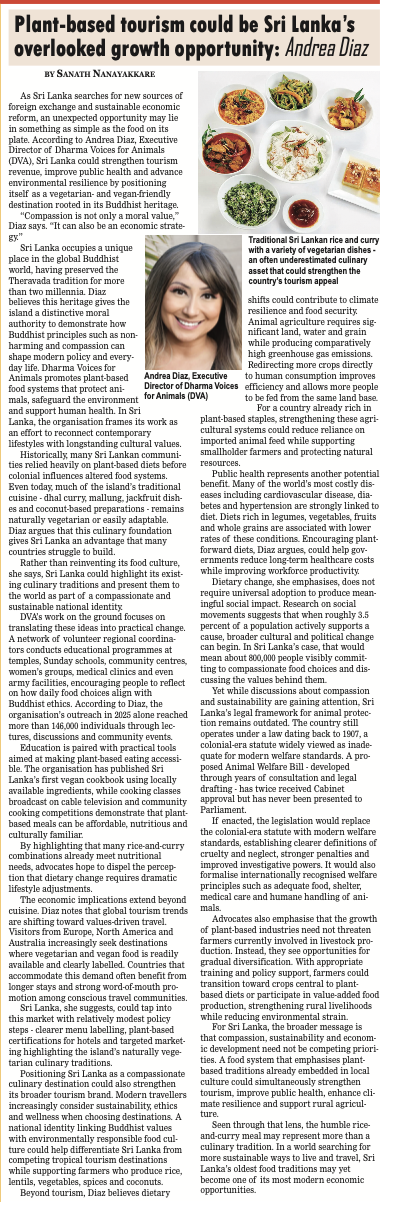
This article was published by Sanath Nanayakkare in The Island’s Financial Review after Executive Director Andrea Diaz’s trip to Sri Lanka in 2026.
As Sri Lanka searches for new sources of foreign exchange and sustainable economic reform, an unexpected opportunity may lie in something as simple as the food on its plate. According to Andrea Diaz, Executive Director of Dharma Voices for Animals (DVA), Sri Lanka could strengthen tourism revenue, improve public health and advance environmental resilience by positioning itself as a vegetarian- and vegan-friendly destination rooted in its Buddhist heritage. “Compassion is not only a moral value,” Diaz says. “It can also be an economic strategy.”
Sri Lanka occupies a unique place in the global Buddhist world, having preserved the Theravada tradition for more than two millennia. Diaz believes this heritage gives the island a distinctive moral authority to demonstrate how Buddhist principles such as non- harming and compassion can shape modern policy and everyday life. Dharma Voices for Animals promotes plant-based food systems that protect animals, safeguard the environment and support human health. In Sri Lanka, the organisation frames its work as an effort to reconnect contemporary lifestyles with longstanding cultural values.
Historically, many Sri Lankan communities relied heavily on plant-based diets before colonial influences altered food systems. Even today, much of the island’s traditionalcuisine - dhal curry, mallung, jackfruit dishes and coconut-based preparations - remains naturally vegetarian or easily adaptable. Diaz argues that this culinary foundation gives Sri Lanka an advantage that many countries struggle to build.
Rather than reinventing its food culture, she says, Sri Lanka could highlight its existing culinary traditions and present them to the world as part of a compassionate and sustainable national identity.
DVA’s work on the ground focuses on translating these ideas into practical change. A network of volunteer regional coordinators conducts educational programmes at temples, Sunday schools, community centres, women’s groups, medical clinics and even army facilities, encouraging people to reflect on how daily food choices align with Buddhist ethics. According to Diaz, the organisation’s outreach in 2025 alone reached more than 146,000 individuals through lectures, discussions and community events.
Education is paired with practical tools aimed at making plant-based eating accessible. The organisation has published Sri Lanka’s first vegan cookbook using locally available ingredients, while cooking classes broadcast on cable television and community cooking competitions demonstrate that plant-based meals can be affordable, nutritious and culturally familiar.
By highlighting that many rice-and-curry combinations already meet nutritional needs, advocates hope to dispel the perception that dietary change requires dramatic lifestyle adjustments.
The economic implications extend beyond cuisine. Diaz notes that global tourism trends are shifting toward values-driven travel. Visitors from Europe, North America and Australia increasingly seek destinations where vegetarian and vegan food is readily available and clearly labelled. Countries that accommodate this demand often benefit from longer stays and strong word-of-mouth promotion among conscious travel communities.
Sri Lanka, she suggests, could tap into this market with relatively modest policy steps - clearer menu labelling, plant-based certifications for hotels and targeted marketing highlighting the island’s naturally vegetarian culinary traditions.
Positioning Sri Lanka as a compassionate culinary destination could also strengthen its broader tourism brand. Modern travellers increasingly consider sustainability, ethics and wellness when choosing destinations. A national identity linking Buddhist values with environmentally responsible food culture could help differentiate Sri Lanka from competing tropical tourism destinations while supporting farmers who produce rice, lentils, vegetables, spices and coconuts.
Beyond tourism, Diaz believes dietary shifts could contribute to climate resilience and food security. Animal agriculture requires significant land, water and grain while producing comparatively high greenhouse gas emissions. Redirecting more crops directly to human consumption improves efficiency and allows more people to be fed from the same land base.
For a country already rich in plant-based staples, strengthening these agricultural systems could reduce reliance on imported animal feed while supporting smallholder farmers and protecting natural resources.
Public health represents another potential benefit. Many of the world’s most costly diseases including cardiovascular disease, diabetes and hypertension are strongly linked to diet. Diets rich in legumes, vegetables, fruits and whole grains are associated with lower rates of these conditions. Encouraging plant-forward diets, Diaz argues, could help governments reduce long-term healthcare costs while improving workforce productivity.
Dietary change, she emphasises, does not require universal adoption to produce meaningful social impact. Research on social movements suggests that when roughly 3.5 percent of a population actively supports a cause, broader cultural and political change can begin. In Sri Lanka’s case, that would mean about 800,000 people visibly committing to compassionate food choices and discussing the values behind them.
Yet while discussions about compassion and sustainability are gaining attention, Sri Lanka’s legal framework for animal protection remains outdated. The country still operates under a law dating back to 1907, a colonial-era statute widely viewed as inadequate for modern welfare standards. A proposed Animal Welfare Bill - developed through years of consultation and legal drafting - has twice received Cabinet approval but has never been presented to Parliament.
If enacted, the legislation would replace the colonial-era statute with modern welfare standards, establishing clearer definitions of cruelty and neglect, stronger penalties and improved investigative powers. It would also formalise internationally recognised welfare principles such as adequate food, shelter, medical care and humane handling of animals.
Advocates also emphasise that the growth of plant-based industries need not threaten farmers currently involved in livestock production. Instead, they see opportunities for gradual diversification. With appropriate training and policy support, farmers could transition toward crops central to plant-based diets or participate in value-added food production, strengthening rural livelihoods while reducing environmental strain.
For Sri Lanka, the broader message is that compassion, sustainability and economic development need not be competing priorities. A food system that emphasises plant-based traditions already embedded in local culture could simultaneously strengthen tourism, improve public health, enhance climate resilience and support rural agriculture.
Seen through that lens, the humble rice-and-curry meal may represent more than a culinary tradition. In a world searching for more sustainable ways to live and travel, Sri Lanka’s oldest food traditions may yet become one of its most modern economic opportunities.